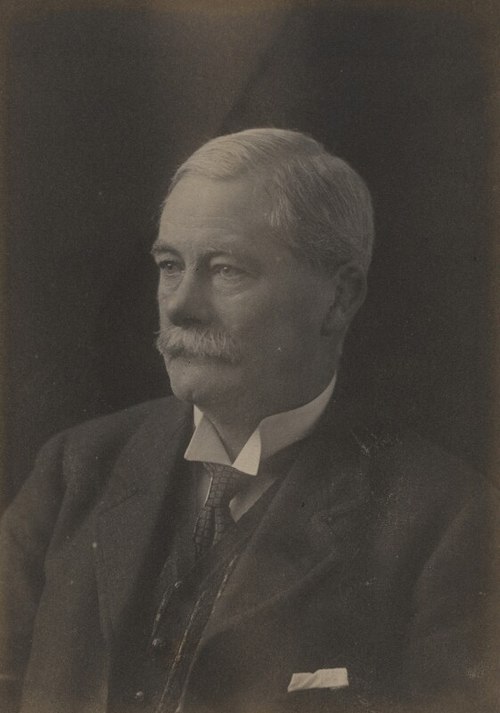
 Herbert Hall Turner FRS (August 13, 1861 – August 20, 1930) was a prominent British astronomer and seismologist whose life integrated major scientific milestones, academic
leadership, and historical cultural connections.
Herbert Hall Turner FRS (August 13, 1861 – August 20, 1930) was a prominent British astronomer and seismologist whose life integrated major scientific milestones, academic
leadership, and historical cultural connections.Queer Places:
Clifton College, 32 College Rd, Clifton, Bristol BS8 3JH, United Kingdom
University of Cambridge, 4 Mill Ln, Cambridge CB2 1RZ
University of Oxford, Oxford, Oxfordshire OX1 3PA
Herbert Hall Turner FRS (August 13, 1861 – August 20, 1930) was a prominent British astronomer and seismologist whose life integrated major scientific milestones, academic
leadership, and historical cultural connections.
Born in Leeds, England, to an artist father, Turner received his early education at Leeds Modern School and Clifton College in Bristol before entering Trinity College, Cambridge. At Cambridge, he excelled in mathematics, achieving the status of 2nd Wrangler in the Mathematical Tripos, earning his BA in 1883, and subsequently securing a fellowship alongside membership in the Cambridge Apostles.
In 1884, Turner accepted the position of Chief Assistant at the Royal Greenwich Observatory, where he dedicated nine years of service. During this period, he participated in the solar eclipse expeditions of 1886 and 1887 and contributed extensively to foundational papers on astronomy, celestial photography, tides, and transit observations, which later formed the basis of his 1897 Royal Society candidature citation. His academic career advanced significantly in 1893 when he was appointed the Savilian Professor of Astronomy and Director of the University Observatory at Oxford—a prestigious position he held for 37 years. Alongside John Louis Emil Dreyer, he co-edited the official History of the Royal Astronomical Society 1820–1920, published in 1923.
Within his scientific disciplines, Turner made pioneering contributions. In seismology, he is widely credited with the groundbreaking discovery of deep-focus earthquakes and initiated the systematic compilation of worldwide earthquake data. In astronomy, he played a vital role in international charting projects and is credited with coining the astronomical term "parsec." Furthermore, Turner played a whimsical yet permanent role in planetary nomenclature in 1930; after eleven-year-old Oxford schoolgirl Venetia Burney suggested naming the newly discovered outer planet "Pluto" to her grandfather Falconer Madan, the name was passed to Turner, who officially cabled it to the Lowell Observatory in the United States.
Turner married Agnes Margaret Whyte in 1899, with whom he had one daughter, Ruth. He maintained an active professional life until his sudden death from a brain haemorrhage on August 20, 1930, while attending a scientific conference in Stockholm, Sweden. His legacy is preserved through his scientific discoveries, historical records, and a portrait by Catharine Dodgson that hangs at New College, Oxford, honoring his long tenure as a professorial fellow.
References:
 The Cambridge Apostles, 1820-1914: Liberalism, Imagination, and Friendship in British Intellectual and Professional Life 1st Edition by W.C. Lubenow |
Other references:
Support this project
This website is a passion project researched, developed, and funded entirely by me. If you find the content valuable and would like to help support the ongoing research and hosting costs, any contribution is deeply appreciated.
Thank you for keeping this independent resource alive!
My books on Amazon: Elisa Rolle's books